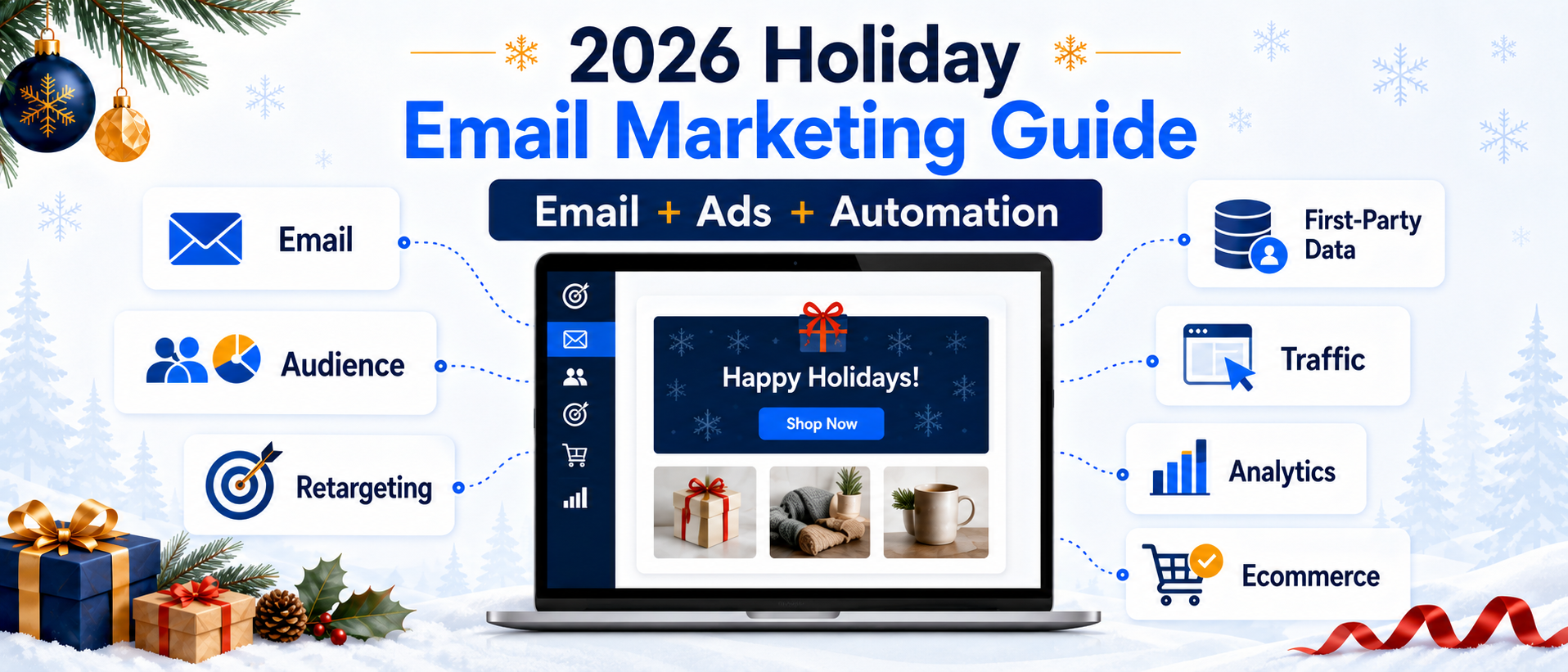
This holiday email marketing guide covers what businesses need in 2026: a plan that is more competitive, more fragmented, and more dependent on first-party customer data than in past years.
Consumers now move between email, Google Search, social media, websites, online marketplaces, and physical stores before they buy anything. At the same time, economic pressure is making shoppers more selective. As a result, early forecasts suggest that consumer caution could slow retail and ecommerce growth in the 2026 holiday season.
In other words, businesses cannot rely on a few Black Friday emails and hope customers respond.
Instead, a strong 2026 holiday marketing strategy should treat email as the central channel while supporting it with paid search, social advertising, retargeting, content marketing, SMS, website personalization, and marketing automation.
Email provides direct access to customers who have already expressed interest in your business. Advertising, meanwhile, helps you reach new prospects and bring past visitors back. Your website then completes the sale. When these channels share consistent messaging and audience data, each one becomes more effective.
Throughout this holiday email marketing guide, you will find a complete framework for connecting email with your broader digital marketing efforts—along with practical steps you can start using today.
Why Email Should Be the Center of Your Holiday Email Marketing Guide
Digital advertising platforms are powerful, but businesses do not own their audiences on Google, Facebook, Instagram, TikTok, or other third-party platforms.
Algorithms change. Advertising costs fluctuate. Targeting options can disappear overnight, and accounts can be restricted without much warning. On top of that, competitors can bid on the very same audiences and search terms you rely on.
Your email list, however, is different.
When someone gives your business permission to email them, you gain a direct communication channel that does not depend on whether an advertising platform decides to show your content.
In particular, email is valuable during the holidays because it can support every stage of the customer journey:
- Introducing an upcoming promotion
- Announcing early access
- Recommending relevant products or services
- Recovering abandoned shopping carts
- Reminding customers about deadlines
- Promoting gift cards
- Sharing shipping information
- Encouraging repeat purchases
- Following up after the holiday season
FireDrum Email Marketing supports businesses that want to manage campaigns themselves, as well as organizations that need managed email marketing services and strategic assistance.
Ultimately, the goal is not simply to send more emails. Rather, it is to use customer data, segmentation, timing, and automation to send messages that feel relevant to each recipient.
Get Help Managing Your Holiday Campaigns →
Start Planning Earlier Than You Think
Holiday shopping is no longer limited to the window between Thanksgiving and Christmas.
Major retail events, marketplace promotions, early-access campaigns, and extended Black Friday offers have trained customers to start researching and buying gifts earlier. For example, Amazon’s June 2026 Prime Day event generated an estimated $26.4 billion in U.S. ecommerce spending—proof of how strongly shoppers respond to major promotional events well before the traditional holiday season.
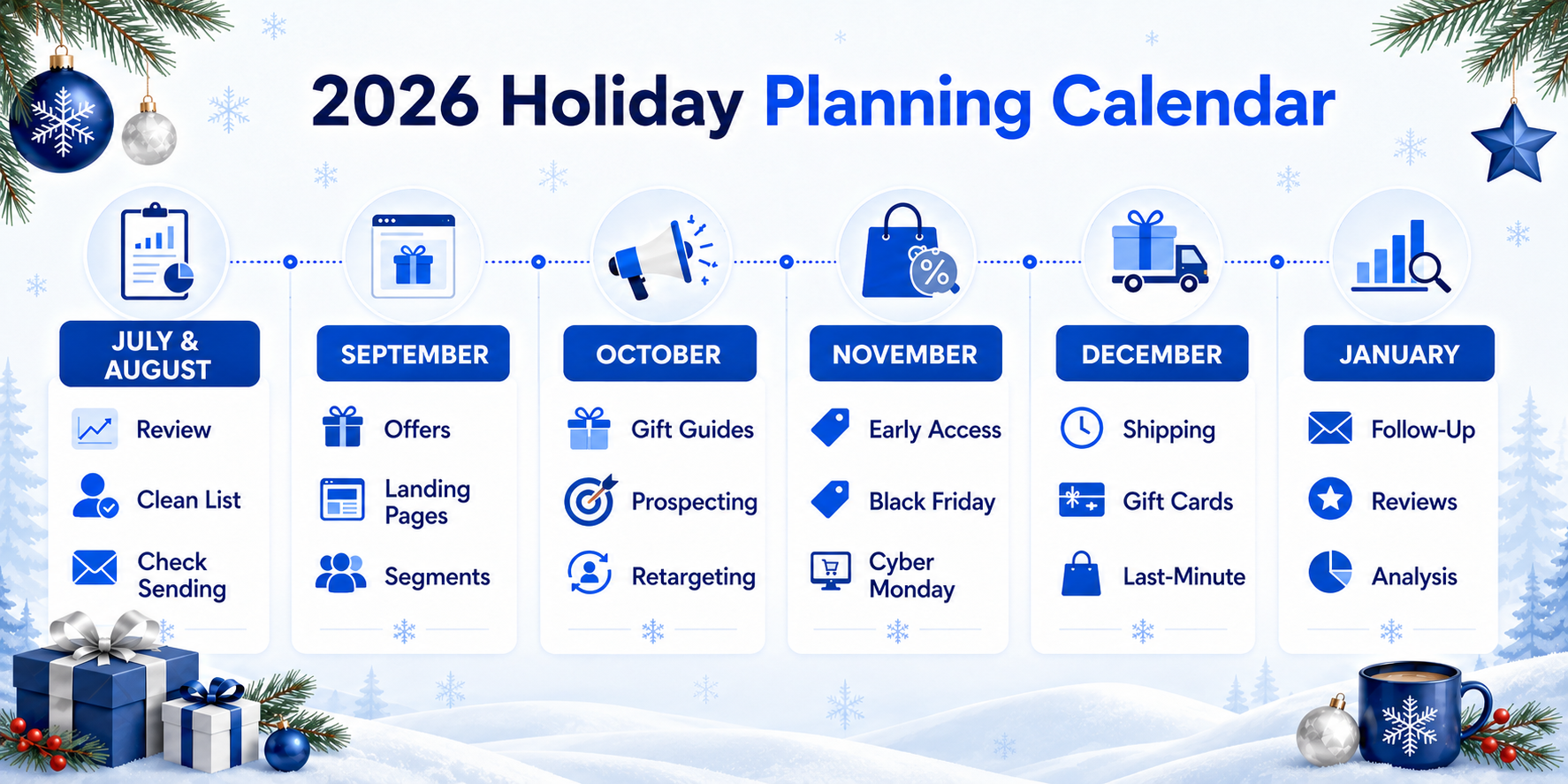
Because of this shift, most businesses should begin holiday planning during the summer. A recommended planning schedule looks like this:
July and August
Review the previous holiday season. Identify your highest-performing products, services, campaigns, subject lines, offers, landing pages, and customer segments, and look for weaknesses such as low deliverability, abandoned carts, slow website pages, unclear offers, or inconsistent tracking. Meanwhile, begin cleaning your email list and checking your sending infrastructure.
September
Finalize your primary holiday offers, then build promotional landing pages, email templates, audience segments, advertising creative, tracking systems, and automated campaigns. This is also a good time to start growing your email and SMS lists with early-access incentives.
October
Begin gift guides, educational content, product recommendations, and holiday planning campaigns. Similarly, launch prospecting ads now to build website traffic and retargeting audiences before advertising costs increase later in the season.
November
Increase campaign frequency around early-access promotions, Black Friday, Small Business Saturday, Cyber Monday, and Giving Tuesday. However, use segmentation so you are not sending every promotion to every subscriber.
December
Shift messaging toward shipping deadlines, gift cards, local pickup, service availability, last-minute shopping, and post-Christmas promotions.
January
Follow up with customers, request reviews, promote complementary products, reactivate new subscribers, and analyze campaign performance.
Holiday campaigns built at the last minute usually depend on discounts, simply because there is not enough time to create a more compelling strategy. Starting early, on the other hand, gives your business time to build anticipation, collect new contacts, test messaging, and develop multiple reasons for customers to buy. FireDrum’s email campaign planning guide covers the broader framework this schedule fits into.
Build and Protect Your Email List Before the Holidays
A large list is not automatically a valuable list.
In fact, the quality of your contacts affects engagement, deliverability, conversions, and sender reputation. A smaller list of interested subscribers will usually outperform a larger list filled with inactive, outdated, purchased, or poorly sourced contacts. That is why, before increasing your holiday email volume, you should review your database and remove or suppress:
- Invalid email addresses
- Hard bounces
- Repeated soft bounces
- Previous unsubscribes
- Known spam complaints
- Long-term inactive contacts
- Addresses collected without clear permission
Do not purchase email lists. Purchased contacts are unlikely to recognize your business, which raises the risk of unsubscribes, spam complaints, and poor engagement. This kind of list cleanup is also the first step toward stronger list hygiene and deliverability heading into the holidays. For a deeper technical walkthrough, FireDrum’s knowledge base also explains why organic list growth supports better deliverability.
Instead of buying contacts, grow your list through the marketing channels you already have. Useful holiday list-building opportunities include:
- Website popups offering early access
- Holiday giveaway registrations
- Gift guide downloads
- In-store signup forms
- Checkout opt-ins
- Loyalty program enrollment
- Social media lead campaigns
- Event registrations
- Referral promotions
- VIP sale waiting lists
Above all, clearly explain what subscribers will receive. “Join our newsletter” gives people very little reason to subscribe, while “Get early access to our Black Friday sale” provides an immediate, specific benefit.
Consent and transparency have also become increasingly important, as customers pay closer attention to how businesses collect and use their information. FireDrum recommends using segmentation and personalization while respecting customer consent and maintaining transparency around data usage.
Make Deliverability a Priority
A holiday email campaign cannot generate sales if it never reaches the inbox.
Mailbox providers evaluate more than the content of an individual email. They also consider authentication, sender reputation, complaint rates, engagement history, unsubscribe practices, list quality, domain alignment, and sudden changes in sending volume. With that in mind, businesses should confirm that their email infrastructure includes:
- SPF authentication
- DKIM authentication
- DMARC authentication
- Proper domain alignment
- A working unsubscribe process
- One-click unsubscribe support where required
- Accurate sender information
- A consistent sending domain
FireDrum’s knowledge base walks through exactly how to set up your DKIM, DMARC, and SPF records, which is worth bookmarking before your holiday volume increases.
Google and Yahoo introduced stricter requirements for bulk senders in 2024, and enforcement has only become more consistent since. Similarly, Microsoft implemented comparable authentication requirements for high-volume senders to Outlook, Hotmail, and Live.com addresses in 2025.
Generally speaking, Google classifies organizations sending approximately 5,000 or more messages per day to personal Gmail accounts as bulk senders. These senders are expected to authenticate messages with SPF and DKIM, publish a DMARC policy, support one-click unsubscribe for applicable promotional messages, and maintain a low spam complaint rate.
Do not wait until Black Friday to discover an authentication or reputation problem. Instead, test deliverability before your holiday volume increases, and monitor bounced emails, complaints, unsubscribe rates, and engagement along the way. Avoid suddenly sending to your entire database after months of inactivity—if your list has not been contacted recently, gradually reintroduce sending volume, starting with your most engaged contacts.
Segment Your Holiday Audience
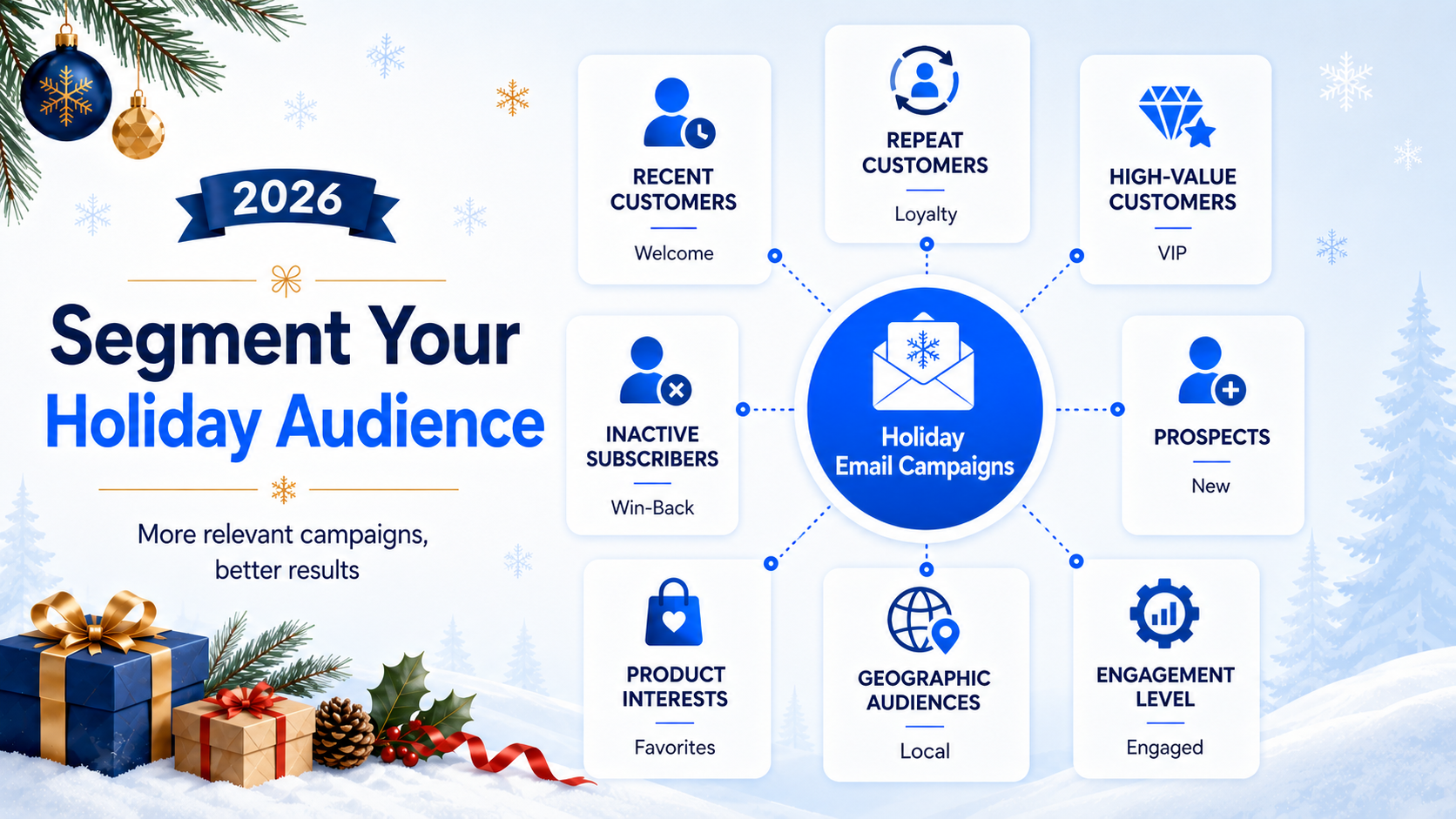
The same promotion will not appeal equally to every subscriber, which is exactly why segmentation matters.
Segmentation lets you group contacts based on characteristics or behavior, then send campaigns that feel more relevant to their interests. FireDrum’s list segmentation resources recommend evaluating customer attributes and behavior to identify useful audience segments, including geography, demographics, customer stage, preferences, and past campaign activity.
Useful holiday segments include:
Recent customers
These customers already trust your business. Promote complementary products, replenishment items, service upgrades, accessories, or gifts related to their recent purchase.
Repeat customers
Reward loyal customers with early access, exclusive bundles, loyalty points, private sales, or limited products.
High-value customers
Protect the relationship instead of overwhelming these customers with generic promotions. Consider personal recommendations, premium offers, account manager outreach, or early ordering opportunities.
Prospects who have never purchased
Focus on your strongest introductory offer, customer reviews, guarantees, popular products, and clear reasons to choose your business.
Inactive subscribers
Use a reengagement campaign before placing these contacts into your primary holiday campaign, since continuing to send frequent promotions to people who have ignored your emails for months can damage performance.
Category or product interests
Use browsing behavior, previous clicks, downloads, purchases, or stated preferences to recommend relevant products and services.
Geographic audiences
Local businesses, including retail businesses, can segment by service area, store location, pickup availability, event location, or weather conditions.
Engagement level
Your most engaged contacts may tolerate a higher holiday email frequency, while less engaged contacts should receive fewer, more selective messages.
Segmentation does not need to be complicated. Even separating customers from noncustomers can significantly improve your messaging.
Create a Holiday Offer Strategy
Discounting is common during the holidays, but it should not be your only strategy.
Constant discounts train customers to wait for the next sale and can quietly reduce profit margins. Instead, strong holiday campaigns combine pricing incentives with convenience, urgency, exclusivity, added value, and trust. Potential offers include:
- Percentage discounts
- Fixed-dollar discounts
- Free shipping
- Free local delivery
- Buy-one-get-one offers
- Product bundles
- Service packages
- Gift-with-purchase promotions
- Loyalty bonuses
- Early-access sales
- Limited-edition products
- Gift cards with a bonus
- Extended warranties
- Free consultations
- Priority scheduling
- Charitable donation matches
Whatever you choose, your offer should be easy to understand within a few seconds. Avoid promotions with multiple exclusions, complicated discount tiers, or unclear redemption requirements—customers should immediately understand what they receive, how to claim it, and when the offer expires.
For price-sensitive audiences, emphasize savings and practicality. For premium audiences, emphasize exclusivity, craftsmanship, availability, service, or convenience.
Consumer caution is expected to shape the 2026 holiday season, which may make clear value propositions more important than broad brand messaging. FireDrum’s Cyber Week campaign is one example of building a full offer strategy around a single seasonal event rather than a single generic discount. For a broader look at budget-smart holiday planning, SP Marketing Experts’ guide to holiday marketing strategies that maximize every dollar is also a useful companion resource.
Build a Complete Holiday Email Calendar
A holiday campaign should tell a connected story rather than repeat the same sale announcement over and over. A complete email sequence may include the following phases.
Phase 1: List growth and anticipation
Begin by encouraging customers to join your early-access list. Possible messages include:
- Holiday shopping is coming
- Join the VIP list
- Get first access
- Download our gift guide
- Reserve holiday availability
- Update your preferences
The primary goal here is simply to collect information and identify interested contacts.
Phase 2: Education and discovery
Next, help customers decide what to purchase by sending gift guides, best-seller lists, product comparisons, customer favorites, staff recommendations, service planning information, frequently asked questions, and shipping and return policies. This phase reduces uncertainty before the promotion begins.
Phase 3: Early access
Give your most valuable or engaged contacts the opportunity to purchase first. Early access creates urgency without immediately relying on a public deadline, and it also gives your business a chance to test your website, checkout process, promotional codes, and fulfillment system before the full campaign launches.
Phase 4: Main promotion
Announce your primary sale with a direct subject line, a concise explanation, clear visuals, and one main call to action. Do not bury the offer beneath a long introduction; customers should understand the promotion immediately.
Phase 5: Reminder
Remind people who opened but did not purchase, clicked without purchasing, or never opened the original campaign. Rather than resending the exact same email to everyone, change the subject line, opening message, featured product, or reason to act.
Phase 6: Final deadline
Send a clear final reminder shortly before the offer ends, and state the deadline accurately. False urgency, or repeatedly extending a supposedly “final” sale, damages trust quickly.
Phase 7: Fulfillment and last-minute options
As shipping deadlines approach, transition to:
- Local pickup
- Digital gift cards
- Printable certificates
- In-stock merchandise
- Appointment scheduling
- Experiences
- Subscriptions
- Electronic delivery
Phase 8: Post-purchase follow-up
Finally, thank customers, provide delivery information, explain how to use the product or service, and recommend an appropriate next step. The post-purchase experience often determines whether a holiday customer becomes a long-term customer.
Use Marketing Automation to Capture Missed Revenue
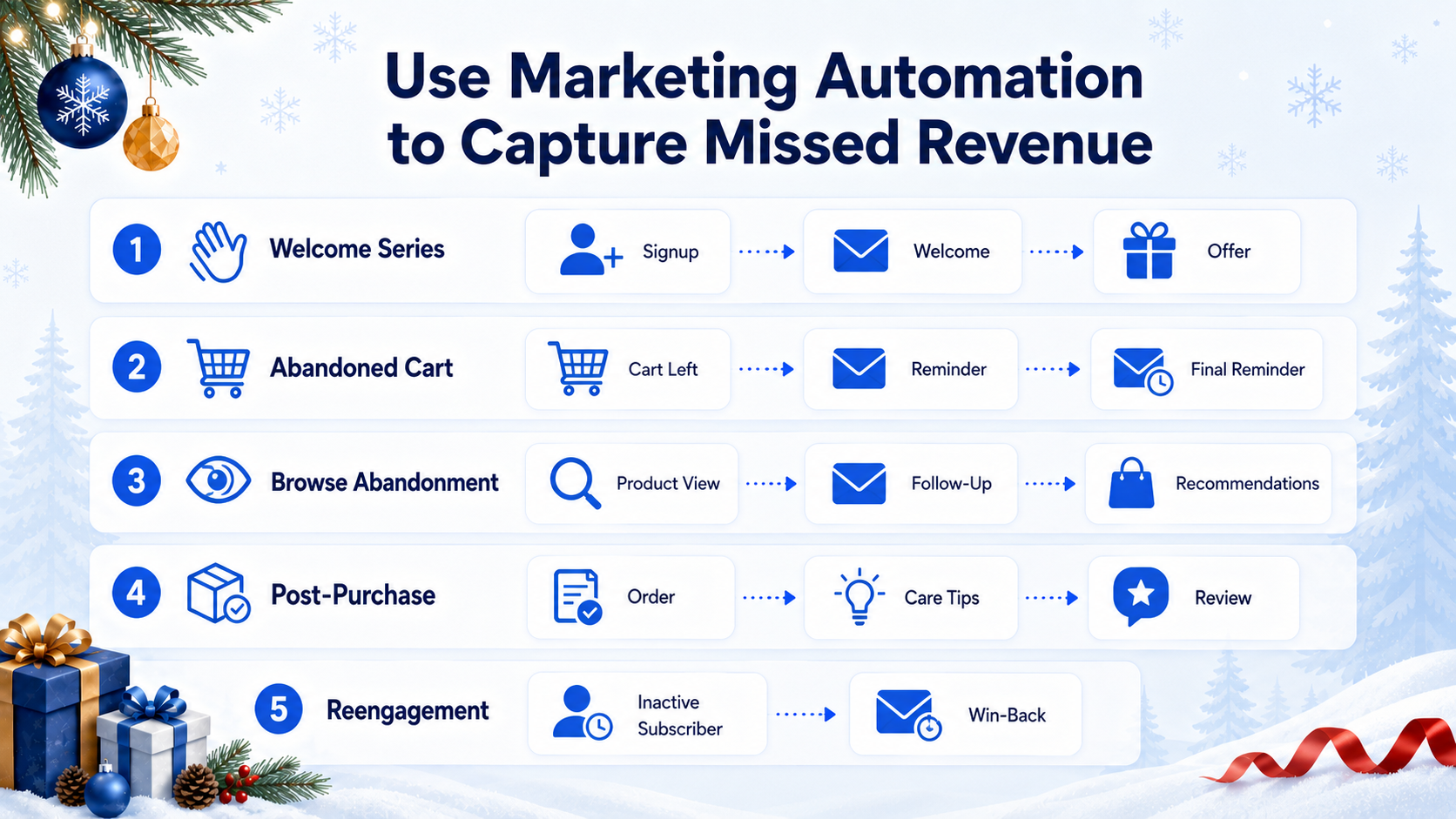
Automation lets businesses respond to customer behavior without manually sending every message. FireDrum’s automation guidance emphasizes that effective workflows begin with clearly defined audiences and thoughtful segmentation. Important holiday automations include:
Welcome series
Introduce new subscribers to your business, explain what makes your offer different, feature popular products or services, and set expectations for future emails. During the holidays, adjust your welcome series to include current promotions and deadlines.
Abandoned cart series
Send reminders when customers add items to their cart but do not complete the purchase. A useful sequence might include a simple cart reminder, followed by product benefits, reviews, or frequently asked questions, and finally a reminder tied to availability or a legitimate deadline. Avoid offering a discount immediately in the first email—some customers only need a reminder.
Browse abandonment
Follow up with contacts who viewed a product or service but did not add it to their cart. The message can include the viewed item, related recommendations, customer reviews, or helpful buying information.
Post-purchase series
Confirm the purchase, explain what happens next, provide care or usage information, request a review, and recommend complementary products.
Reengagement campaign
Ask inactive subscribers whether they still want to receive emails, and offer preference options or a compelling reason to return.
Back-in-stock and low-inventory alerts
Notify interested customers when popular items return or when genuine inventory limitations exist.
Appointment and service reminders
Service businesses can automate consultation confirmations, appointment reminders, preparation instructions, and follow-up messages.
Ultimately, automation works best when it responds to a specific customer action. Generic automated messages may save time, but behavior-based automation creates a far more relevant experience.
Connect Email Marketing with Google Ads
Email and Google Ads serve different purposes: email helps you communicate with known contacts, while Google Ads helps you reach people actively searching for products, services, solutions, or competitors.
During the holidays, use Google Ads to capture demand created by your email campaigns and other marketing activities. For instance, a customer may receive your promotional email, remember your company later, and search for your brand rather than clicking the original email. Without a coordinated search strategy, competitors may appear above your organic listing. Recommended holiday Google Ads campaigns include:
Branded search campaigns
Protect searches for your company, product names, promotional events, or signature services.
Product and service campaigns
Target searches connected to specific holiday needs, gifts, services, deadlines, or local availability.
Shopping campaigns
Ecommerce businesses can use product feeds to show images, pricing, availability, and merchant information directly in search results.
Remarketing campaigns
Reach previous website visitors who did not purchase.
Customer list audiences
Where platform rules and consent requirements allow, businesses may use first-party customer lists to create audience signals, exclusions, or targeted campaigns.
Google’s advertising platforms continue to lean on automation and machine learning. However, advertisers still need strategic control over campaign structure, conversion tracking, creative assets, search terms, budgets, and audience quality. Research covering 2026 Google and Meta advertising trends notes that increased platform automation can also increase the operational complexity required to maintain cross-channel control—which is why many businesses lean on a specialist. SP Marketing Experts’ PPC and Google Ads management services are one option worth exploring if this feels like more than your team can manage alone.
Your email campaigns can also improve paid search decisions. For example, email engagement may reveal which products, offers, headlines, or customer concerns are generating interest, and those insights can then be folded into ad copy and landing pages.
Connect Email Marketing with Meta Advertising
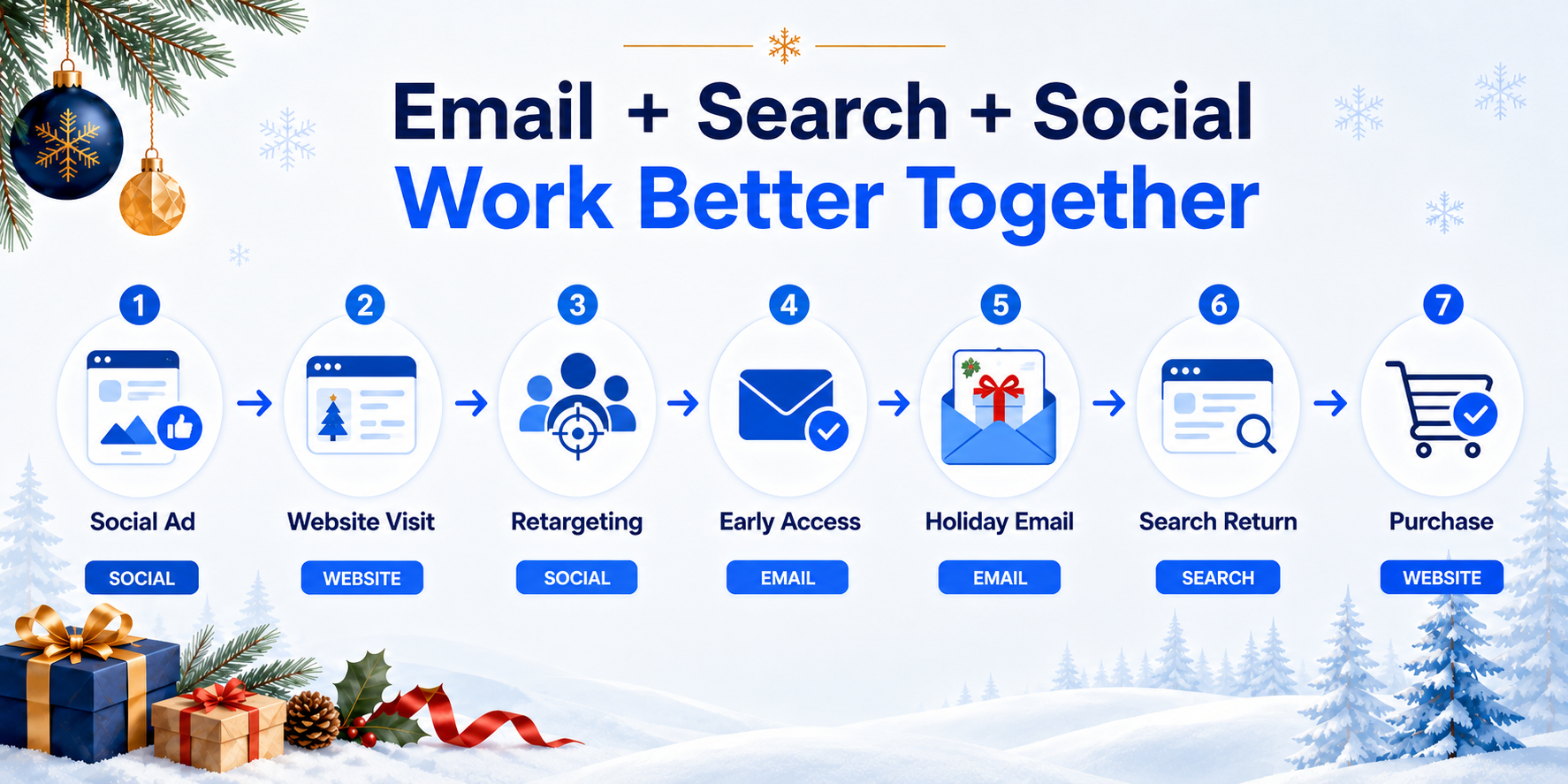
Meta advertising can support holiday campaigns through Facebook and Instagram prospecting, retargeting, lead generation, video advertising, catalog campaigns, and customer list audiences—reaching people before they even begin actively searching.
A coordinated campaign might work like this:
- A customer sees a video or carousel ad on Instagram.
- They visit the website but do not purchase.
- They are added to a retargeting audience.
- They subscribe for early access.
- They receive a holiday email sequence.
- They see follow-up ads featuring the products they viewed.
- They return through an email or ad and complete the purchase.
The advertising and email creative should look and sound connected—use consistent product photography, offer language, deadlines, landing pages, and calls to action. Creative content is becoming increasingly important to Meta campaign performance, since automated systems now rely heavily on ad content and engagement signals to find audiences. That means it pays to prepare multiple creative versions before the season begins. Test:
- Product demonstrations
- Customer testimonials
- Short videos
- Static product images
- Lifestyle photography
- Gift guides
- Founder messages
- Before-and-after examples
- Problem-and-solution messaging
- Deadline reminders
Avoid running one advertisement for the entire season, since customers may see the same creative repeatedly, leading to fatigue and declining response. If managing this level of creative testing and social ad coordination sounds like a lot, SP Marketing Experts’ social media management services are built to handle exactly this kind of ongoing campaign work.
Use Retargeting to Reinforce Email Campaigns
Not every subscriber opens every email, and not every website visitor subscribes—retargeting closes part of that gap.
Create audiences based on:
- Website visits
- Product page visits
- Cart activity
- Video views
- Lead form engagement
- Social media engagement
- Customer status
- Previous purchases
Be sure to exclude recent purchasers from advertisements that promote the same product they just bought. Show complementary products, loyalty benefits, referral offers, or post-purchase information instead. Overall, email and retargeting should reinforce one another without becoming repetitive: a subscriber who clicked a gift guide email might later see an ad featuring the most relevant category, while a customer who bought a product should enter a post-purchase email sequence and exit the acquisition campaign. This kind of coordination reduces wasted advertising spend and creates a smoother customer experience. If you are unsure whether your current retargeting setup is actually paying off, SP Marketing Experts’ look at whether programmatic ads are actually working is a helpful gut-check.
Build Holiday Landing Pages That Convert
Do not send every email and advertisement to your homepage. Instead, create dedicated landing pages for major offers, gift categories, audiences, and seasonal services. FireDrum’s own Cyber Week landing page is one example of a focused seasonal page built around a single offer.
A strong holiday landing page should include:
- A clear headline
- The primary offer
- Relevant products or services
- High-quality images
- Customer reviews
- Shipping or scheduling deadlines
- Return or cancellation information
- Payment options
- Frequently asked questions
- A clear call to action
The message on the landing page should match the email or advertisement that brought the visitor there. If an ad promotes “Gifts Under $50,” the landing page should immediately show products under $50—do not make the visitor search for them. Finally, test the complete purchasing process on mobile devices, and confirm that promotional codes work, forms are easy to complete, buttons are visible, payment options function properly, and pages load quickly.
Coordinate Email with Organic Social Media
Organic social media can extend the reach of your holiday campaign, but it should not simply repeat your email copy. Instead, use social platforms to show aspects of the campaign that work better visually or conversationally. Examples include:
- Product demonstrations
- Behind-the-scenes preparation
- Employee gift recommendations
- Customer stories
- Countdown posts
- Inventory updates
- Frequently asked questions
- User-generated content
- Short educational videos
- Live product demonstrations
Use this content to drive people toward your email list, gift guide, holiday landing page, or promotion. Email can then step in with more detailed information and follow-up communication than a social post ever could.
Use Content Marketing and SEO to Capture Holiday Searches
Holiday content can attract customers before they are even ready to purchase. Create useful content around the questions people ask while researching gifts, services, events, and year-end decisions. Potential topics include:
- Gift guides by price range
- Gifts for specific audiences
- Holiday preparation checklists
- Product comparison guides
- Shipping deadline information
- Local holiday resources
- Year-end service planning
- Frequently asked holiday questions
- How to choose the right product
- Last-minute gift ideas
Publish content early enough for search engines to find and evaluate it, then use email and advertising to drive initial traffic. Strong engagement can help you identify which topics deserve additional promotion. A single gift guide can support multiple channels at once—it can become a blog post, downloadable resource, email campaign, social media carousel, video topic, paid advertisement, and landing page, similar to how FireDrum’s pre-made holiday email templates can be repurposed across a season. If SEO strategy is not your team’s strength, SP Marketing Experts’ SEO services focus specifically on capturing this kind of seasonal search demand.
Add SMS Without Overwhelming Customers
SMS can be effective for urgent, time-sensitive communication, but it should be used selectively. Appropriate holiday SMS messages include:
- Early-access alerts
- Sale launch announcements
- Final deadline reminders
- Pickup notifications
- Appointment reminders
- Back-in-stock alerts
- Delivery updates
Do not send a text message for every email. Reserve SMS for moments where immediacy actually matters, obtain proper consent, identify your business clearly, and provide an opt-out option. FireDrum’s guide to combining SMS and email marketing covers how the two channels can work together without overwhelming subscribers. In short: email should carry the details, while SMS delivers the alert and points customers to the next step.
Track the Entire Customer Journey
Open rates alone will not tell you whether a campaign generated revenue. Privacy features and automated image loading have made email open data less reliable as a standalone metric, so treat opens as a directional signal rather than the final measure of success. Instead, track:
- Delivered emails
- Bounce rate
- Spam complaint rate
- Unsubscribe rate
- Click-through rate
- Click-to-open rate
- Website sessions
- Product views
- Form submissions
- Add-to-cart activity
- Completed purchases
- Revenue per recipient
- Average order value
- Cost per acquisition
- Return on advertising spend
- Repeat purchase rate
Use consistent UTM tracking parameters across email links, advertisements, social posts, and partner campaigns, and confirm that Google Analytics, advertising pixels, ecommerce tracking, CRM data, and email reporting are all recording the correct actions. Remember, customers often interact with several channels before purchasing—someone may first discover your business through an Instagram ad, subscribe through your website, click two emails, search your brand on Google, and finally purchase directly. Evaluate each channel’s role instead of assigning all the credit to the final click.
Test Before the Season Begins
Testing should happen before your highest-volume campaigns, not during them. Test:
- Subject lines
- Preheaders
- Sender names
- Offers
- Calls to action
- Email layouts
- Product order
- Images
- Plain-text versions
- Mobile display
- Landing pages
- Forms
- Checkout
- Promotional codes
- Tracking links
- Automated campaign triggers
Send test messages to multiple email providers and devices, and check Gmail, Outlook, Yahoo, Apple Mail, desktop displays, and mobile screens along the way. Confirm that images include alternative text, and that the message still makes sense if images are blocked. Above all, do not redesign your entire strategy during Black Friday week—use earlier campaigns to figure out what works first.
Avoid Common Holiday Email Marketing Mistakes
The most common problems include:
Sending every campaign to the entire database
This creates irrelevant messaging and increases fatigue.
Increasing volume too quickly
Sudden spikes can create deliverability problems, especially when the list has not been contacted consistently.
Depending entirely on discounts
Price is only one reason to purchase—convenience, trust, availability, service, exclusivity, and relevance matter too.
Using vague subject lines
Customers should understand why the message deserves their attention.
Hiding the offer
Place the primary message near the top of the email.
Sending traffic to the homepage
Use a relevant landing page that continues the campaign message instead.
Ignoring mobile users
A difficult mobile experience can waste both email and advertising traffic.
Failing to exclude purchasers
Continuing to advertise the same offer to recent customers wastes money and creates frustration.
Using false urgency
Misleading deadlines damage trust quickly, and rarely earn it back.
Ignoring deliverability
Authentication, consent, list quality, and sender reputation should be addressed before promotional volume increases. FireDrum’s email marketing best practices checklist covers several of these fundamentals in more detail.
A Practical 2026 Holiday Campaign Framework
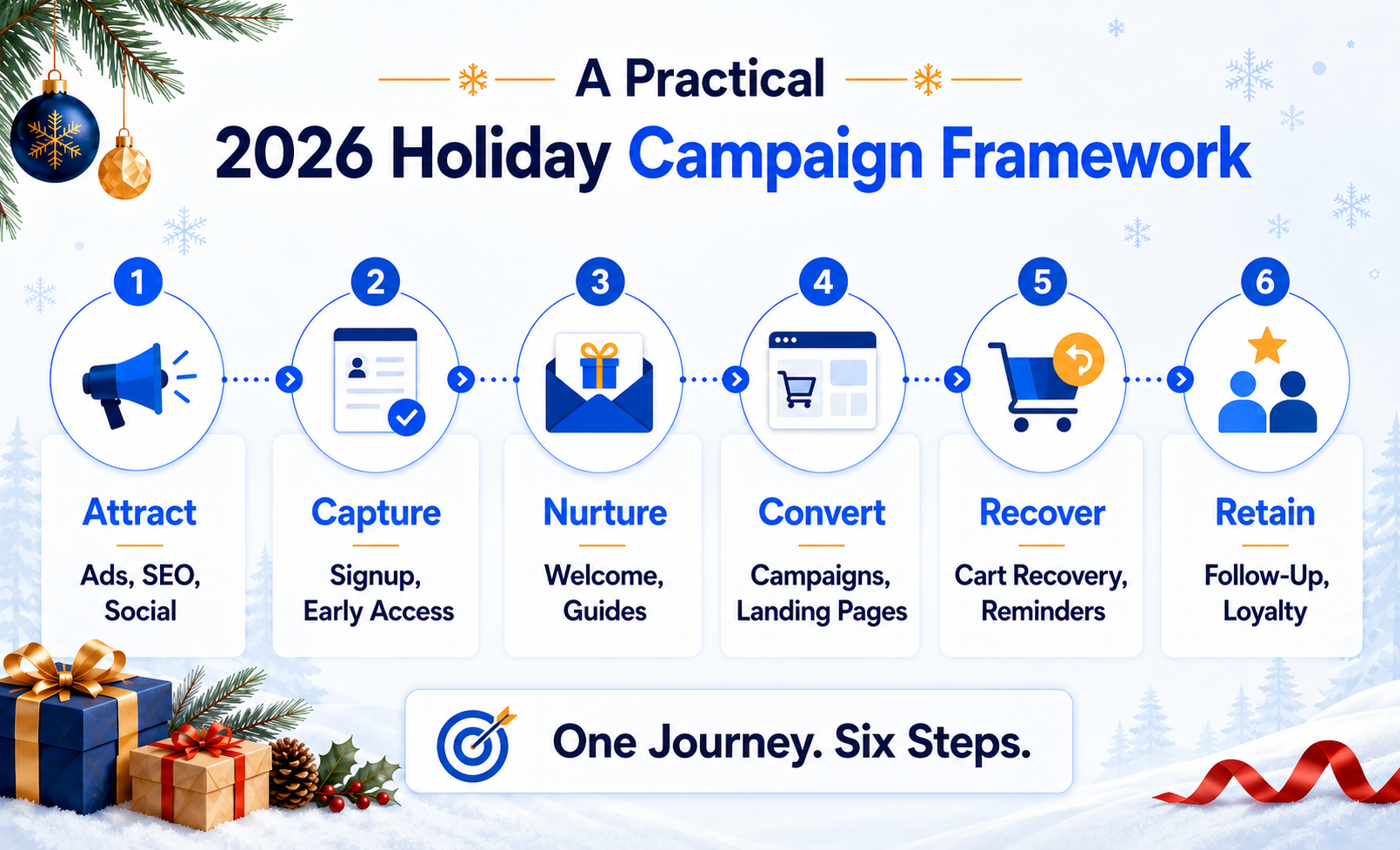
A coordinated campaign can follow this structure:
Step 1: Attract
Use Google Ads, Meta ads, social media, SEO content, referral programs, and offline promotion to attract potential customers.
Step 2: Capture
Encourage visitors to join your email list through early access, useful content, discounts, giveaways, or preference-based signup forms.
Step 3: Nurture
Use welcome emails, gift guides, educational content, customer reviews, and product recommendations to build confidence.
Step 4: Convert
Launch your offer through segmented email campaigns, retargeting advertisements, search campaigns, SMS alerts, and dedicated landing pages.
Step 5: Recover
Use cart abandonment, browse abandonment, remarketing, and deadline reminders to recover missed purchases.
Step 6: Retain
Follow up with delivery information, product education, review requests, loyalty offers, referrals, and complementary recommendations.
This approach treats email as part of a complete marketing system rather than a separate promotional activity.
See FireDrum Pricing & Plans →
Prepare Your Holiday Email Marketing Strategy with FireDrum
The businesses that perform best during the 2026 holiday season will not necessarily send the most emails or offer the largest discounts. Instead, they will build reliable customer data, protect their sender reputation, segment their audiences, create clear offers, automate important follow-ups, and coordinate email with advertising and website activity.
FireDrum Email Marketing provides email marketing solutions for businesses that want to manage campaigns internally, as well as companies that need hands-on campaign management and strategic support, with plans built around different business needs.
Start planning before inboxes and advertising platforms become crowded. Review your list, confirm your email authentication, build your campaign calendar, prepare your creative, connect your tracking, and determine how email will work alongside Google Ads, Meta advertising, social media, SEO, SMS, and your website. A connected strategy, in the end, gives customers multiple opportunities to discover your business, understand your offer, and complete a purchase.
That is the core idea behind this entire holiday email marketing guide: no single channel wins the season on its own.
Talk to FireDrum About Your Holiday Strategy →
FAQs
When should I start planning holiday email marketing?
Most businesses should begin holiday planning during the summer. Reviewing last year’s performance in July and August, finalizing offers in September, and starting list growth and content in October gives a campaign time to build momentum before Black Friday and Cyber Monday.
How many holiday emails should I send?
There is no fixed number. Frequency should depend on segmentation and engagement level. Highly engaged subscribers can typically handle more frequent messages during peak weeks, while less engaged contacts should receive fewer, more selective campaigns.
Should holiday email marketing rely on discounts?
No. Discounts are common, but relying on them exclusively trains customers to wait for sales and can reduce margins. Convenience, urgency, exclusivity, added value, and trust should be part of the offer strategy alongside pricing incentives.
How does email marketing work with Google Ads and Meta advertising during the holidays?
Email nurtures known contacts, while Google Ads and Meta advertising extend reach to new prospects and previous website visitors. Coordinating messaging, offers, and audience data across all three channels keeps the customer experience consistent from first ad to final purchase.
What automations matter most for a holiday campaign?
A welcome series, an abandoned cart series, browse abandonment, a post-purchase series, and a reengagement campaign are among the most valuable holiday automations because they respond directly to customer behavior instead of relying on manual sends.
How can I keep holiday email campaigns out of the spam folder?
Confirm SPF, DKIM, and DMARC authentication, maintain a clean and permission-based list, avoid sudden spikes in sending volume, monitor complaint and unsubscribe rates, and test deliverability before your highest-volume campaigns begin. FireDrum’s knowledge base has a step-by-step walkthrough for setting up DKIM, DMARC, and SPF records if you have not configured these yet.